Rapid LVV Titer Without p24 ELISA: What Each Method Actually Counts
p24 ELISA is the default physical titer assay for lentiviral vectors, and it earned that position: it is well characterised, widely available and inexpensive per plate. But it answers a narrower question than most people assume, and it answers it in hours rather than minutes. For teams looking for a rapid LVV titer without ELISA, the useful comparison is not speed alone — it is what each method physically detects, and therefore which one can be trusted at which point in the workflow.
This page compares the two measurements head to head. For the full range of titration approaches including genome-based and functional assays, see our overview of lentiviral vector quantification.
What p24 ELISA actually measures
A p24 ELISA quantifies the HIV-1 p24 capsid protein in your sample. It does not count particles. The particle number is inferred, by dividing the measured protein mass by an assumed number of p24 molecules per virion — a conversion factor that is a literature average, not a property of your preparation.
Three consequences follow, and all three matter most in exactly the samples you most want to measure:
- Free p24 is counted as if it were virus. The assay detects p24 whether it is assembled into a particle or floating unincorporated in the supernatant. Producer cells release substantial free p24, so unprocessed harvests can be considerably over-estimated. The bias is largest upstream and shrinks as purification removes soluble protein — which means the assay’s error changes systematically along your process.
- The conversion factor is an assumption. Particles per nanogram of p24 varies with construct, producer cell, culture conditions and packaging efficiency. Applying a fixed factor across a process campaign quietly imports that assumption into every yield calculation.
- Aggregation is invisible. A monomeric particle and a hundred-particle aggregate contain the same p24 per virion. A preparation that has aggregated will return an unchanged p24 titer while behaving completely differently in the process and in the patient.
None of this makes the assay wrong. It makes it an indirect measurement whose bias depends on sample context, which is a reason to pair it with something that counts particles directly rather than a reason to abandon it.
Direct particle counting: a different measurement
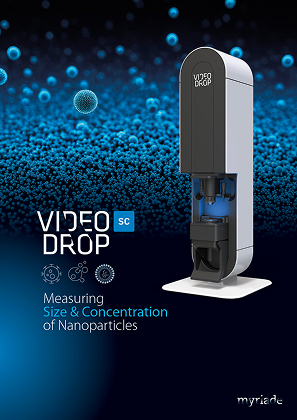
Rather than inferring particle number from a protein, interferometric light microscopy (ILM) detects the nanoparticles themselves. The principle behind the Videodrop SC is that a camera and dedicated signal processing detect the interference between the light scattered by each individual particle and the incident beam, returning a number-based size distribution and a concentration in particles/mL from a single 5–10 µL drop, in under a minute, label-free and non-denaturing.
Lentiviral vectors sit comfortably inside the measurement window: particles are approximately 100–130 nm in diameter, above the ~80 nm detection threshold, and typical process samples fall in the 108–1010 particles/mL working range. This is the application for which the instrument is best positioned.
Side by side
| p24 ELISA | Direct particle counting (ILM) | |
| What is detected | p24 capsid protein, incorporated or free | Nanoparticles, individually |
| Particle number is | Inferred via a conversion factor | Measured directly |
| Type of titer | Physical, indirect | Physical, direct |
| Turnaround | Several hours (plate, incubations, washes) | Under a minute per sample |
| Sample volume | Assay-dependent, plus dilutions | 5–10 µL, recoverable |
| Consumables | Antibody kit, plates, standards | No kit, no label, no calibrant |
| Size information | None | Number-based size distribution |
| Aggregates | Invisible | Visible in the live image, up to 10 µm |
| Free protein | Counted as signal | Not counted as particles |
| Distinguishes vector from other particles of similar size | Yes, p24 is vector-specific | No — counts all particles in range |
The final row is the one that keeps ELISA in the workflow, and it should not be glossed over. p24 is specific to the vector; an optical particle count is not. In a crude harvest containing cell debris, membrane fragments and vesicles of similar size, a direct count measures total particles, of which the vector is only a fraction. Specificity and directness are traded against each other, and each method holds one of them.
What the independent evidence shows
ILM particle counting was evaluated independently by Turkki et al. (Viruses, 2021), who tested it on lenti-, adeno- and baculovirus preparations against traditional titering methods. Their conclusion is directly relevant to where you place the method: it is especially useful for high-concentration, purified virus preparations, while certain non-purified sample types or very small viruses may be difficult to characterise, or may require standard-curve or background-subtraction strategies that lengthen the analysis.
That maps precisely onto the specificity limitation above. Downstream of clarification, where debris has been removed and the vector dominates the particle population, a direct count and a p24 titer converge. Internal data collected in partnership with a gene-therapy developer supports this: across multiple fractions and batches, ILM particle counts correlated closely with p24 ELISA (R² ≈ 0.97) and with RT-qPCR (R² ≈ 0.90). Upstream, in crude harvest, the two measurements diverge — and they diverge for opposite reasons, ELISA inflating on free p24 and particle counting inflating on non-vector particles.
Where each belongs in a vector core workflow
The practical answer for most cores is not substitution but sequencing:
- Use direct particle counting for in-process and screening decisions. A minutes-long, low-volume measurement can be run on every fraction, every batch, every day — which is what makes step recovery and process troubleshooting possible at all. See real-time lentivirus titer during purification for how this plays out across the downstream train.
- Keep p24 ELISA for specificity and for reporting. Where a vector-specific number is required — comparability, documentation, external communication — the specificity of the assay is exactly what you are paying for.
- Keep a functional assay for the dose that matters biologically. Neither a p24 titer nor a particle count tells you how many particles can transduce a cell. The physical-to-infectious ratio is itself a quality indicator, and it requires both numbers.
Used this way, the fast count becomes a gatekeeper: screen broadly and often, then commit ELISA, qPCR and functional assays to the samples and stages where they genuinely add information.
Honest limits
Three constraints should be clear before you plan around this. The measurement is a physical titer only — it says nothing about infectivity. It is not vector-specific, so crude, debris-laden material needs care in interpretation. And the working range of 108–1010 particles/mL means very concentrated final product still requires dilution, though far less than assays needing extensive dilution series.
Whichever combination you adopt, report the method alongside the value. Titers from different assays are not interchangeable, and a lentiviral titer quoted without its assay cannot be compared across sites, batches or publications.
Key takeaways
- p24 ELISA measures a protein and infers particles through an assumed conversion factor; free p24 inflates crude harvests.
- Direct particle counting measures particles and size in under a minute, and shows aggregates that p24 cannot see.
- ELISA keeps one decisive advantage: p24 is vector-specific, an optical count is not.
- Peer-reviewed evaluation places direct counting best on purified, high-concentration preparations — screen fast there, confirm with orthogonal assays.
Want a lentiviral titer in under a minute? See how the Videodrop SC measures physical titer and size in a single drop — request a demonstration.
Choose your application



Choose your product
Measuring
Size & Concentration
of Nanoparticles
Size Kinetics
and Aggregation
of Nanoparticles